Discover how Jake Allen, a Chicago-born street artist and finance pro, is redefining the future of art, currency, and creative entrepreneurship! From being rejected by art professors to showcasing Bitcoin-powered artwork at the Bitcoin Conference in Las Vegas, Jake’s story is one of grit, innovation, and disruption.
In this episode, hosted by John LaRoy, Jake shares how he blends passion, finance, and merch with purpose. He talks about his powerful partnership with Apparel Redefined, how he brings Bitcoin into physical artwork, and why merch is more than just t-shirts—it’s a movement.
If you’re a creator, entrepreneur, or just curious about Bitcoin, digital art, or merch branding, you don’t want to miss this.
Key Highlights
• Introduction and Background of Jake Allen 0:01
• Jake’s Transition from Art to Finance 3:31
• Jake’s Introduction to Bitcoin 5:52
• John LaRoy’s Perspective on Bitcoin and Jake’s Journey 8:17
• Jake’s Disruptive Mindset and Future Vision 16:46
• Jake’s Relationship with Apparel Redefined 17:16
• John LaRoy’s Insights on Business and Marketing 21:21
• Jake’s Vision for the Future of Art and Bitcoin 26:54
• Jake’s Personal and Professional Growth 35:55
• Final Thoughts and Advice 37:52
Transcription
Curt Anderson 00:01
Hey guys, happy whatever day it is to you out there. So that’s Thursday for us. John, happy Thursday to you, man,
John LaRoy 00:07
happy Thursday. Curt, I am pumped today, because today, today we got, I know we say this every time, but we really do have a rock star in a specific niche that we have not had any guests on yet talking about this stuff. So I’m really excited,
Curt Anderson 00:20
man. I don’t know where you find these amazing human beings, dude, do you have, like, you have the magic touch we gotta. We’ll have to talk about that offline. But hey, I’m gonna give a big shout out and a huge introduction to our dear friend, Jake Allen, Jake, how are you, dude?
Jake Allen 00:33
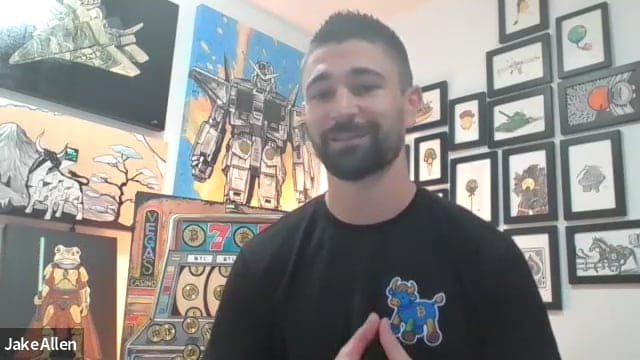
Good. Thanks for having me. Guys. Uh, first podcast I’ve been on, so it’s exciting. Figured out decorate the space with some of my artwork and trying to bring some new artwork onto the scene. So it’s really cool to partner with a company like Apparel Redefined. Talk about basically what we have in common today and a lot of what we’re launching into the future, and kind of just explore a new topic with the guests, with the viewers today, and talk about basically how we found each other and why some of our interests and hobbies cross paths, and I think people really like what we have to say.
Curt Anderson 01:03
Well, all right, Jake, let’s you know what. We’re not pulling any punches. We got a ton of cover, so we’re going to dive right in, man. So you’re a Chicago kid, found your way in Colorado. Next thing you know, like you and your wife and your newborn child, you’re hanging out in Wyoming. You’ve got all sorts of wonderful artwork going on. So give us a little background on who’s Jake, and then I want to dive into, like, everything over your shoulder, all this incredible artwork. And we’re going to be diving into Bitcoin. As John said, this is a new topic for us today. So Jake, take it away, man. Let’s start wherever you want to start.
Jake Allen 01:33
Yeah, absolutely. So to give everyone kind of the gut punch background, my artwork has always stem from a street art basis. So I grew up coming from Chicago, obviously being influenced by that culture. A lot of what the city provided for us, just looking up to it, visiting the city as a kid, it was always a treat. Obviously, we had our distance for certain reasons at certain times, but I think overall, it was an awesome experience, especially with the food culture. God, I miss the Chicago food. But long story short, I eventually divulged into really researching art and just becoming, you know, an artist by practice and by trade. Right? They say, do 20 minutes of something every day and you’ll be a master of it in, you know, 10,000 hours or something along those lines. So really, my passion was just keep practicing and find out more about what it means to be an artist. So over time, I was really getting into New York art, and street art in New York really decided to catch my attention, and eventually it became international, to the point where I was following Banksy, a really well known international artist, and I think he’s done just a hell of a job at breaking boundaries in the art world, and it’s something I’ve always been fascinated with. So as an artist, what I try to do is disrupt boundaries, disrupt the train of thought. I had a lot of art teachers really disagree with me growing up because of the way that I chose to portray my artwork, to the point where, like, even in college, I’d have professors like, rip my artwork off the wall and let it fall in front of the whole class. You’re just sitting there. You’re like, alright, this is alright, this is a learning lesson, but it’s also going to light that fire under my butt for the future. So it’s one of those things where I think pouring your soul into the art and just finding new ways to be creative and disruptive, that’s been a passion of mine. And on X, you could find me artwork by ja, and I think that’s going to be a new topic. And pursuit into the future is finding ways to disrupt more than art. I think Bitcoin serves as a perfect platform for that.
Curt Anderson 03:31
Alright, so let’s go here. Jake, so you’re a finance guy by trade. You’ve worked you know, some of the biggest, amazing finance companies now. Did you ever, did you see yourself like, when you’re in college, you had this artist flair. Did you see, like you’re kind of like Rose art colliding, right? Like you’re kind of bringing a little bit of your finance expertise with your passion for art. Can you kind of walk us through that a little bit? Will
Jake Allen 03:52
you? Yeah, it was really interesting. You know, from, I would say, high school, I started printing. I was a huge fan of hockey in high school and sport, Chicago sports. So we started printing, like sports apparel at our local, you know, t shirt companies. And I worked in a union in Chicago growing up, so just kind of marketing to those crowds, even between school, between, you know, my jobs, and trying to find people that, hey, you want to buy a cool graphic kind of T shirt, I started exploring kind of these different markets growing up, and I think over time, the connection of business and artwork kind of clicked in my head. So going to school for marketing made sense, and then getting a minor in studio art proved to be just a complete headache. If I’m being perfectly honest, there was a lot of like, art history classes where I was just sitting there thinking, Man, I could be spending all this time really practicing the craft rather than learning about the philosophies of the craft. And I think that’s a big statement for any business nowadays, is, you know, get out there and make footsteps, even if you’re going to step in the mud more often than not. At least, you’re out there walking instead of talking about the idea of where you could walk. So. So for me, that was kind of a breaking ground. Was learning from high school, obviously into college, how to transition that from like, Okay, this is just art for fun, making T shirts for fun and selling them, making a couple 100 bucks here or there, to turning it into a more practical application. I experimented with, like websites like Etsy in college, had zero success. I think the algorithms and the way that, you know, content is meant to be marketed. I mean, back in the day, if you even put, you know, a gun or a rifle in a painting, you’d get flagged, and you get just kind of shadow banned. So not knowing that shadow ban was even a thing before it came out and was real, it’s like we have these obstacles in life that the only way to be the most effective is by putting your boots on the ground, so to speak.
Curt Anderson 05:48
Okay, so just, you know, having that finance background, how did walk us through, like, you know, Bitcoin, how it got on your radar, how it became part of your passion? Let’s walk us through, and especially for folks were maybe bitcoins new to them, you know, talk about your story, your journey, and just kind of dive into the whole Bitcoin experience from your perspective.
Jake Allen 06:07
Yeah, absolutely. So I kind of stumbled into finance just coming from a marketing background. I was just basically marketing my skill set, right? And then you find your job out of college, by luck and by nature. So finding the industry of finance, I think, was kind of by mistake, but it ended up teaching me a lot about the real life application of wealth and money and just transactionally what we can do, right? I know back in the day when smartphones didn’t have the same capacities that they do now, like everybody was plugging in their their card transact, there wasn’t QR codes, even there wasn’t ways that we could digitally transact phone to phone or peer to peer. So the evolution of that in itself, is a similar parallel to like, watching art, you know, kind of evolve how we have digital artists now we’ve got, we had the whole NFT run. I think there was a lot to be learned. Just looking at the first like kind of Bitcoin synopsis. So when I was in college, I want to say maybe price action was under 10,000 still. And so if we look at that today, you know that’s maybe 10 years of my life, we’ve seen a 10x so it’s an impact, impeccable when you compare that as kind of a new asset class compared to traditional stocks or traditional finance, where there’s kind of this flat dollar associated with it and based on, you know, US currency. So my my interest in it really stems from, okay, the cross between art and the future of currency, the true peer to peer, decentralization of how we want to value each other is, if you handed me $100 today, you know that can be worth less in the future, whereas if I got $100 for painting, I were to transact with you in Bitcoin today, the thought is that, you know, the artist could gain appreciation from that in the future, and you have a painting That’s then worth more money in the future. So it’s a win win, in my opinion. And I just kind of see this new divergence from traditional finance, from traditional art, in the same capacity that like we see the divergence of like people that want to express themselves freely on platforms get the divergence from the algorithms for being kind of kicked out from being shown. It’s harder to present artwork on certain platforms than other platforms. And I think that now the challenge is, you know, who’s who’s just remaining busy, who’s staying busy enough to be relevant, and if we all continue to work hard, that’s the best strategy we have at this whole thing going forward. So that’s kind of how finance tied in with me, was learning that the underlying principle is just, you know, go to work, work hard. You don’t have to give up your day job for your passion, but at the same time, don’t give up on working some working towards something you love. You know, even in my job, there’s a lot of ways that I’m creative every day, but I don’t let that negate me from, you know, being explorative in my artwork, in my free time.
Curt Anderson 09:07
Awesome. Excellent answer, John. Let’s get you in the game here now before So Jake, before I get dive into like, that incredible head of hair that he has. John, look at that gray head of hair that he has. But, all right, John, what are your thoughts on this conversation so far? What do you what’s, what’s going through your mind a
John LaRoy 09:21
lot. I mean, we talked a little bit last week, you know, I’ve been, I’ve been in the Bitcoin and crypto game, you know, since about 2019 2018 and it is interesting because, you know, you see iterations of time in history. You have, like, a major disruptor, and you have a period of uncertainty, of a period of beating the incumbent or the upcoming technology or style, you know, like the Renaissance period, you know, all those guys got shit on for a while, right? And then it became the thing. You just have these, these, these patterns repeating itself. Um. Yeah, but, yeah, it’s just, it’s so interesting, because my whole thing was, like, I was just interested in Jake’s, like, how did you get in finance? And, like, especially where and how much he was doing in the finance world, and not having that background from college, right? You know, that’s, that’s a lot, but it’s all about his performance and what he did and how he believed in himself, and I’m just really working hard, right? That you know, the people at that firm or those firms, recognize how hard he was working and realized that there’s something more for this kid if he wants to continue this and that’s something like Jake’s talked about his passion. I think he’s fortunate, because at a young age, I think you figured out what your passion was, there’s a lot of people that don’t, right? And one of the things that we talk about Curt all the time is, I kind of cringe when people say, follow your passion, because I would say 95% of people have no idea what their passion is, and that passion at 16 is not what their passion will be at 40, right? I know for sure that’s the case of me. So my thing is always bring your passion to whatever you’re doing, right? And you could interchange passion and energy, but there you don’t get passion without energy. So you gotta have the energy to go into whatever you’re going to do like a bull in a china shop to make sure you’re going to be, you know, it’s hard to be the best at everything, right? But you can look in the mirror and say, I gave it my all right? And I think that’s really important. But I just admire Jake, because he’s definitely done that in a multitude of different spaces, and has had the freedom to always stay grounded in the artwork that I feel like he’s really identified that passion and continue to build, not only his skill set, but his his niche. You know, we talk about Curt all the time about niching down until it hurts, right? I don’t think you can niche down any more than Jake has. I mean, it’s got to hurt, you know, of where he’s, where he’s created art in a space from having a, you know, an elitist Professor tear his shit off the wall, you know, it, it’s hard to, if I was in that situation, to hold back and not want to pull his jersey over his head and and mess him up a little bit, right? But you just use that. You just add that chip on your shoulder, and eventually, you know, it takes time, but it’ll, it’ll come back. So, yeah, just, just awesome, awesome. Props to you, Jake for everything you’ve done thus far.
Curt Anderson 12:18
Thank you. Yeah, Jake, so let’s, let’s, the big word that’s hitting me with this conversation is disrupter. I want to talk to, like, Where was that in your DNA? Would that come like, somebody was there disruptors in your family, in your household, you know, growing up in Chicago, where, like, you kind of have this, this. What the heck? Disrupting attitude, like, where’s this come from?
Jake Allen 12:38
Yeah, of course. I’ve always, honestly, I’ve always admired like the small business owner. My parents were small business owners, so they kind of kicked ass in their own own niche as well growing up. So I think just learning from people that stepped out of the boundaries of, Hey, you don’t have to go put the suit and tie on and sit there every day, that was always kind of an admirable place for me to be. It’s funny because, like, people talk about, oh, you know, what did you want to be growing up, and stuff like that. It’s like we got, like, I think my passion growing up from like fourth grade on till I can’t even remember, was like, being a helicopter pilot. I’m like, then one day I figured out I was like, super good at art, and I’m like, Okay, I think I need to stick with this. Like, this makes a whole lot more sense than just trying to take a stab in the dark to become a helicopter pilot. Not that I couldn’t have it’s just one of these things where you gotta follow where the cards are being dealt. It’s kind of how I look at life, and especially with the finance regard of it, and not really just being complacent in that regard. COVID was kind of one of the most interesting things to happen because it created this remote workspace, and everybody kind of looked at this as, this is a new gray area, right? Like, are we going to get businesses that sit on their ass because they can be behind a computer and work from the comfort of their own home, or are we going to get innovators? Are we going to get intuitive people and truly disruptors to the nature of what it means to do business. So I kind of give props to the whole mess of that, because I think it showed, it showed the world that, hey, there’s still a spark in the fire of we can be creative as business owners, as employees, everybody can choose whether they want to work hard or whether they want to sit back and relax. And the people that didn’t choose to sit back and relax are the ones that are showing as successful today, the other people, I mean, you’ve seen them kind of flop or just become stagnant in nature. And when John mentioned you know that this is sort of the Renaissance, I couldn’t agree more. I think there’s many more renaissances to be had like this is one art Renaissance to me, of plenty more in the future. It’s Bitcoin for the next 100 years, in my opinion. And I think we’ve had Fine Art renaissances before, but traditional art markets are dead to me, just like Fiat is die. Ying to me. So I think we have this like interesting conundrum between, you know, fine art galleries that are going to become, you know, emptier and emptier over time, because there’s not the same desire for that. People are going to want to see the excitement same thing in business. I think people are going to want to see what’s the next level that we could take product to and deliver to the consumer? What’s the best way that the customer experience can benefit in the end? Is it something that ongoingly gives them satisfaction? I mean, that’s that’s where my mind starts to spin. And as an artist, just being a disrupter Curt to get back to even more. It’s not just painting anymore. Like to me, becoming the Picasso of my generation and becoming the greatest artist in the world, it would mean someone who could sit at an Outback Steakhouse, pick up the kids, pack of crayons and then create the Mona Lisa, like from memory, it’s that type of artist. It’s where your tool is the pen. But the pen doesn’t literally just mean pen and pencil. It means any medium you pick up, you end up becoming such a, you know, desirable artist that, like people, want to follow your movement. It’s not just about your work at that point. So I think that should be the goal for everybody, is to have a desired end state where you want that type of you want that reaction from people with your artwork. So for me to disrupt now I’m taking my artwork beyond the canvas. So I’m starting to install like digital crypto tickers that hook up to your Wi Fi in a painting. So now I have a painting behind me that displays the price of Bitcoin at all times, but it’s also looks like a sweet painting on my wall behind me. So it’s these little things that, you know, we can change and innovate and disrupt and, you know, adding metal, physical bitcoins onto the physical canvas, it’s like, wow. People don’t expect to see a metal coin when they’re looking at fine art. So how do we change the mindset of what’s meant to be believed for this space, and then continue to, like, push that with every aspect of business. I mean, what’s capable with the t-shirt industry, I think still is only scratching the surface of what’s capable in the future.
Curt Anderson 17:13
Yeah, I love that. That’s a perfect segue. I wanted, man. So for folks out there that are, you know, pretty like, Bitcoin newbies, you know, they’re kind of like, hey, what does art have to do with like, I thought Bitcoin was like a virtual currency, and so I You’re doing a great job, kind of walking us through and explaining that. So Jake, let’s go here. You mentioned merch. You have a wonderful relationship with our dear buddy Derek at Apparel Redefined. So let’s go into like, your relationship with a pair of redefine and talk a little bit about, like, what merch is doing for you and how it’s helping you
Jake Allen 17:44
grow. Yeah, absolutely. So I mean, merch has been a relationship for about 10 years from my experience of creating products funding from my own pocket. And then it wasn’t always the goal of producing a capital return, as I explained, it was the goal of creating that, that spread of awareness. So what that meant for me over the years was sorting out all the companies that could not cut it and couldn’t hack it. So like a bad employee in a business, you need to trim the fat. And this was one of those cases where, you know, we went through multiple shops between Derek and I, like screen printing out together as friends and, you know, honestly, at times, just as acquaintances in business, where we were like, Hey, we need contractual business done. There’s a third party involved help us out. And we explored a lot of avenues, and we’ve never seen kind of the pinnacle of that until we got to Apparel Redefined. And so with me understanding the relationship of hey, this is a network of friends and relatable personable people that I can interact with that meant a heck of a lot more to me. And from your guys customer service standpoint of things, it wasn’t the relationship where I would come to you and say, Hey, I got five bucks per item for a T shirt, and you guys would say, okay, cool, we’ll get you a black T shirt. It wasn’t, it wasn’t black and white like that, like there was a lot more context behind the conversation of, what’s your application, what is the experience you want to give off to your customers? We think these inks are a good choice for you because of X, Y and Z. Here’s what they will look like given the conditions that you’re in. I mean, those are factors that, as an artist, mean everything to me. If I’m to go to a print shop and have a test print done, where I’m about to spend, you know, hundreds of dollars on my prints. I want to know what gloss versus matte looks like. And a lot of people don’t think of, you know, the detailed items on a line item sheet, even when they’re working with, you know, print shop, for example, or a company as diverse as apparel, where you find where you guys are out of the boundaries of just doing prints. And you guys offer a lot more services that I think open up the door for people to be more creative. So in that regard, I like that you guys are paying attention to the details. As far as you know, what your ink is looking like as the end product, and not just on paper. And then really, for me, the capability that unlocked it all is you guys helped me become a better marketer, I think, because of your business. Position because of the quick turnaround, because of the relationship. It’s something where, you know, I look forward to working with John more in the future, because I think from our talks, we were even exploring the options of like, hey, what would it look like in five years if Apparel Redefined accepted Bitcoin, you know, for t shirt orders or something along those lines, or we had contractual business to where you guys, you know, are able to host, in a sense, host people that create content and create T shirts and, you know, participate in earnings via the Bitcoin network for that and that way, it’s kind of building on the business to business. It’s a new dynamic and a new evolution of what B2B means in commerce, in currency and assets. What we’re creating is something that’s valuable, just not on paper. It’s valuable in terms of the relationship, in terms of the boundaries being set that are new and parameters that are being kind of gaged based on people’s success stories. So I think there’s a lot more in the future that could be explored between Apparel Redefined and artwork by ja. So I’m really intrigued Apparel redefined. Just to give you guys a quick plug, they were super helpful for me. You guys. They set me up for the entire Bitcoin Conference where I’ll be featuring one of my artworks that’s unreleased right now. So I’ll be happy to meet anybody in Vegas and connect with you guys. I’ll be out there for a couple of days, taking time away. Just awesome that my wife is so supportive and helped me out, and it’s given me the time to kind of go out and follow this passion. So super exciting. But you guys have been incredible. Tip to toe, from everything conceptually, to having the product. You guys have nailed it, and I look forward to working with you guys a lot in
Curt Anderson 21:46
the future. Thanks. Ja, I love it. John, what are your thoughts here? Man,
John LaRoy 21:50
I didn’t even have to pay him, and I don’t even have much Bitcoin to give, you know, so no, that was awesome. We appreciate you working. We talked about this too, and we’ve had other guests on right? It’s, I want to say, easy, but you’re motivated to work even harder. For people that have a clear vision and purpose behind what they’re doing, right? It’s not just slinging ink on a shirt to make, you know, an empty profit with real, no real vision or purpose. No. We have a lot of wonderful guests on the show and everyone. It’s crazy how many people are out there with unique, unique passions and unique purposes that are using I feel like one of the most powerful mediums out there, which is a T shirt to convey artwork. Support a message, promote. A message, donate. Back to, you know, like, like these guys here, back to, you know, veterans that have that struggle with, you know, PTSD and stuff like that. And to me, it’s still, you know, you talk about art and a canvas, you know, the t shirt, the black, the white, whatever it is, is a blank canvas. And everyone’s interpretation of the similar thing can be different. And I always love talking to artists, because I am not one, and I appreciate it so much. Of what people are actually able to do, like you said, going to an Outback and just getting a stack of crayons, being able to create that type stuff, I’ve always been blown away with it, because I have horrible handwriting. I have horrible rendition skills. I could see it how it should be done, but I can’t get my hand to do it. So mad props to you, and I appreciate the plug and the amazing testimonial. And again, just just keep crushing and doing what you’re doing. Yeah,
Jake Allen 23:36
absolutely. I mean, it’ll be exciting to see kind of where business goes in the future, like I said. I mean, I look to eventually get an apparel site set up for people that want to kind of follow this movement. And it’s interesting. I think as much as you know the t shirt space is going to evolve, so is the art space, and so is this Bitcoin message, like, we’re at the point where we just broke $100,000 on the podcast. So that’s cool. That was a big achievement for today. But, yeah, I think a lot of people that just want to have fun and convey a similar message, where they’re trying to do honest business with honest people and connect in the right space. You know, I think follow along for the journey, and there’ll be a lot more where we try to not only help each other, John in these spaces, but we just, you know, we want to build each other up, because there’s no success without the support of everyone around you. So surround yourself with good people, and I think good things are bound to happen.
John LaRoy 24:31
I feel like what you said there too is very true. I was listening to a radio or podcast yesterday. It’s like Gen Z, right. You know, they they’ve never lived in a world where there’s been trust in any institution like it has not happened for people in Gen Z. So that mistrust of everything is really driving like, you know, you’ve had these huge conglomerates and these massive companies and these massive PE firms and stuff that kind. Of own, a little bit of everything. And that was like the goal, right? And now this new economy that’s coming in, you know, everyone talks about what they’re doing for small business, but what actually can be done, because it’s such a fight against the Goliath of the Walmarts, right? Or the Amazons, but having these, you know, opportunities enabled by tech to actually connect creator with producer, and not having to go through a conglomerate of how many hands can go out there is really, is really powerful. I mean, like all that art that you have in the background, that can go on a t shirt, right? And you can, you can create scarcity. You can create all different opportunities for people to participate in your artwork beyond just being able to afford a canvas on a wall. That’s an absolutely, you know, phenomenal piece of art. But again, I just want to, I want to touch back on all the stuff that you talked about, about the service, the ink, and everything that goes into what we do. I gotta give props to Derek on that, because that is the vast majority of him, and he’s an artist, and how he’s able to understand interaction of ink, fabric, heat and all that type stuff, and what it does from a decoration standpoint. So I gotta give give shout out words too. That’s that’s more him than than anything else.
Jake Allen 26:16
I love that. I think that should be the message of the day. Be an artist of your own trade, and you do cool stuff.
Curt Anderson 26:25
And I tell you, man, like, you what big, couple big takeaways for me, Jake is, like, you know, I’m thinking, like, the traditional art museum, you know, like, you know, I’ve brought my daughter to, like, you know, the Met New York. And like, you’re like, it’s, it’s such a radical thought of like, hey, you know, like, everything’s different. Why would that be any different than like, like you’re saying, like, whether it’s retail or Netflix taking blockbuster out, you know what I mean? Like, how do you get, how do you create that relationship direct with the customer, the end user, that type of thing you you’ve mentioned earlier. If I can bring this up, you talk about the conference coming up now. You also mentioned a magazine. I believe. Do you have something going on that we can talk about in a Bitcoin magazine?
Jake Allen 27:01
Yeah. Bitcoin magazine will be launching one of my artworks for the first time. So this is actually the first feature in a magazine that I will ever have. So what an honor to have this be the first and foremost. There’s an awesome group that I encourage everyone to follow. It’s art of freedom. If you give them a Google search, art of freedom is an awesome just curation of really cool artists in the Bitcoin space, and there’s such a supportive group that’s really pushed the message for what I think is really neat for anyone to explore. And it’s the mindset of these Bitcoiners that is contagious, right? It’s not just about the coin itself or the price action itself. It’s about the mentality that step outside of your comfort zone in your own trade and become your own artist, right? Like this is the art of currency that we’re current, currently experiencing. So a lot of my artwork in the magazine and in the conference, it’ll be featured around this theme of, you know, like kind of a currency war going on in a light hearted way. And I think there’s an arbitration between, you know, the dollar dying, and kind of how we look at traditional markets, traditional finance, so to speak, we’ve touched on everything A to Z. And it’s not that I’m just a cynical pessimist about the US dollar, or about, you know, currency in general, but I really do feel like there’s ways for us as humans to put our efforts towards creating assets for ourselves that will solidify our future. So for me, if that’s an asset, whether it means Bitcoin, whether it means art, or whether it means art, about Bitcoin or t-shirts with Apparel Redefined and kicking ass and spreading my name around, this is how we’re going to do it. And I think the guerrilla marketing approach has always proved to be fruitful. I think if you’re not out there trying, knowing that you can take 1000 failures and 1000 no’s, you’ll never know what a yes feels like, and it’s that same door knocking approach. So having the Chicago grind is one of the most thankful things I think I was born with. But honestly, the Picasso gene is kind of what I’m trying to ride this out on so we’ll see what the balance ends up being like.
Curt Anderson 29:03
Awesome. Hey, I’m gonna, I might throw a little curve by CURT ball at you. So please forgive me, but all right, you just had a child. Did I catch that correctly? You just had a child. How old? Yeah.
Jake Allen 29:14
So my son, Atlas, is eight months old now, and so the first piece of artwork that’ll ever be exhibited from my my entire selection of artworks will be at the Bitcoin conference in Las Vegas, 2025 and the the title of that piece is called burden of power, and it’ll feature Atlas the Titan, just to give people a preview. So I decided to do the, basically the first biggest showcase of my art on a global scale, in relevation, to a message I’m trying to push about this whole currency war and Bitcoin, and just rope in my son, and it’s been a beautiful experience becoming a father and just spending so much time with him, working from home is truly a blessing. Well.
Curt Anderson 29:59
God bless you, man, nothing better than being a parent. It’s the best thing on the planet. So congratulations to you and your wife. So I’m here’s my curve ball. Let’s see what so little Atlas, eight months old, we’re going to have a 20 year anniversary of this, this little podcast, uh, hopefully I’ll still be here, John, but 20 years from now, we’re going to have, like, a little anniversary of the three of us, and Atlas is going to be in college at that time. Jake, what does Bitcoin? What does the currency? What does the art market? What does it look like 20 years from now, when we have our little anniversary party with Atlas?
Jake Allen 30:29
This is my, this is my big dice roll, people. I think for a lot of people, this will, this will blow the cap off. But I want people to start looking 20 years down the road, imagining that you can go on your local, you know, fidelity or Charles Schwab account, and instead of buying your 100 shares of Apple or Google for your $300 my my big prediction is that 20 years from now, you will not only be able to buy that with $300 USD, you will be able to buy that with point 000, BTC in the future. So I think that we see some type of reserve or backed currency system to where we have financial markets eventually involved in Bitcoin. We’re seeing it now with like ETFs leaking into the space, just to be a finance geek for a second. But as more artists leak into the Bitcoin space. We’re going to get more people from every single industry into Bitcoin. And that’s the whole idea behind the orange pill, right? We want to give the orange pill to as many people as possible to try to help them secure their destiny, to help them secure something that they know is an asset rather than a static part of life.
Curt Anderson 31:40
Love it, John, what are your What are any predictions? On your end, you got two little guys. We have our 20th anniversary party. What’s your prediction?
John LaRoy 31:49
I don’t disagree with Jake. I just, I hope it’s XRP, because that’s what I’m old. I got more of that. But no, I agree. I mean, I think people have this mindset that stuff lasts forever, right? You know, if you were, if you were in the Roman Empire, you never expected, I forgot the name of it, but whatever it was, that currency to end, and then since then, and now, there’s been six or seven other dominant currencies, the longest being. And I think the pound in Britain for 250, years or so. And we’re, we’re right at that, you know, so history, you know, all these those cliches. If you don’t understand it, it’s bound to repeat it, or whatever the cliche is, or idiom. So, yeah, I mean, if you look at what’s happened over the past 1520, years. I don’t think you can dispute that something isn’t happening that is going to disrupt the entire world, because the world’s never been as connected as it is now, when you had a currency fail, you know, six, 700 years ago, it might take a couple months to figure that out on the other side of the world, you know. So it’s just different. It’s different. Anytime there’s change or disruption, you have resistance, you know. I think the the horse and buggy market did not like Henry, Henry Ford, you know, so, and now, I mean, we’re right around the Kentucky Derby, but that whole markets being disrupted by a few few guys that own over 50% of the race horses out there. And I just watch a show on this so it’s on, it’s fresh my mind, but it’s pretty wild, but I do think that it does allow people at some level to participate in a store of value that gold was years and, I mean, for for most of our history on earth here, and then that was taken away from us. And now here’s another tool that you can use, similar to that to participate in the game we call so yeah, I’m excited. I feel like there’s more people thinking about this now than than just three or four years ago, right? You know, I feel like that whole adaptation, or that tribal mentality, you know, it was like a couple guys in a corner of a room talking about it, no one paying attention, because mainstream media was hiding it. And now you’re starting to see mass adaptation when the big boys are instead of berating it, they’re adopting it. So I think you have to pay attention.
Jake Allen 34:23
And I think for the people out there that are wondering, you know, how did an artist and a Bitcoin guy end up talking to a T shirt and multi services and faceted company? The Long story short of it is that I did a lot of my own research on the t shirt industry over years, and, you know, finding a company with basically that superior quality as Apparel Refined is, it was the same thing of me finding Bitcoin like to me, Bitcoin is a superior asset, versus me going out there trying to research a penny stock and giving it my all hoping that the pharmaceutical clearance gets through for, you know, stage four drug. It’s like my my bet, basically, is. To go with something that has more stability. And so what I would encourage a lot of the viewers today to do is do your own research on Bitcoin. You know, don’t rely on someone to tell you that it’s something good like research it as much as possible. Find out the avenue, even with the evolution of the t shirt markets, as I just explained, we see now, people just want to click and have stuff sent to their house. They don’t even want to pick up the phone and call any call anymore, and the people who do want to pick up the phone want to have a meaningful conversation, and I’ll talk to a robot half the time. So there’s this fine balance between, okay, how do we not get outsourced by something that someone can plug in at their own house and rip us off for and cut out all the margins of this being a success? But how do we also provide that balance between the quality, the speed, everything that relates to that, that Qc is what they call in manufacturing, but just going through and finding out, you know, hey, how do we stay on top of the evolution? And I think, you know, for artwork, maybe there will be, I think there’s a lot of artists that, you know, prints were a huge thing for a while, like, click and get a print sent to your house, and it’s like, the scarcity factor for me is more important. I’d rather hand someone a piece of art knowing that, hey, this is created by me when, when I’m gone, that’s it like, that’s cool for me to not have the digital copies out there, in a sense. But I do see a future where it’s like, yeah, maybe you can click and order a canvas with my art, or maybe there’s something more to it. Maybe you can order a piece of my art that has digital equipment already built into it. So you’re not just hanging a crypto ticker on your wall. You’re hanging a piece of artwork by ja that shows you the price of Bitcoin and looks good in your house. I mean, we saw that kind of happen with TVs. They started turning the TVs into paintings. And it’s like, okay, cool. What’s the next step? Are we turning T shirts into TVs next? I don’t know kind of where this goes from here, but I think the important part is that we’re questioning it, and we’re all working our asses off, trying towards a better goal. Yeah, absolutely
Curt Anderson 36:55
love it, Jake and so All right, we’re gonna wind down. And I’ve got one more question for you real quick, folks can find you on x, and what is your handle on x?
Jake Allen 37:04
Yeah, on the x, formerly Twitter artwork by ja, is going to be my handle on there. I will have a website up and running soon, just, you know, priority is just making art and having fun. So appreciate you guys giving me the first spotlight to come out here and just explain what I’m doing and why I’m doing it. I’m really passionate about this stuff. Takes a ton of time away from being a father and being a family man. So I think any opportunity that I get to share a success story and encourage others to get out there and research all this themselves, and, you know, start your trades, start your craft, become your own artist. That’s that’s the message I want to push to people, yeah, absolutely
Curt Anderson 37:42
love it. Jake, so here’s my last question for you of the day, you are corporate guy coming out of college, what you know, phenomenal company that you work for, and now you really have this entrepreneurial spirit. You have just a contagious enthusiasm, man like I’m ready to run through a wall listening to you today. What? How about either to your younger self, maybe to Atlas, maybe to other young entrepreneurs, maybe entrepreneurs my age. Best business advice that you’ve received in your career, what would you like to pass along to folks? What’s the best business advice that you’ve received that you that’s really helped you kind of build your business that as you have right now? That’s
Jake Allen 38:19
a really tough question. Curt just that’s the CURT ball of the day. If you want to say that’s a CURT ball, best business advice, man, there’s been so many good mentors in my life. I think I don’t even know if it’s been advice. I guess I would give the best business advice. Take a shot on someone that maybe you don’t have full confidence in and take a chance once in a while, I think the best networking relationships that I’ve ever found in my entire life is by stumbling into, hey, let’s have a phone call. Let’s jump on a FaceTime. Let’s introduce each other. Being more engaging in life, being outgoing. It’s never going to hurt you. I think, with society now, there’s such this, like social pressure to look a certain way and to act a certain way, and the whole cringe of being behind the phone type of mentality, it’s really killing social skills. So I would encourage anyone, just from my marketing background, from my artist background, from my personal life skills, just go out and market yourself. That’s my best business advice. Like market yourself. It doesn’t have to be that you have this superior talent or that you stand out from a crowd. Just go out and market who you are. And chances are that if you do that enough times, the right door will open for you, or the right connections will be waiting to greet you at the door. I mean, I’ve had just phenomenal business mentors really open my eyes on how other business is done, and they’ve had way more success than me. So that’s a testament to anything. You know, I think, I think that proves to be the pudding. Is that you don’t always have to be the best, but listening to the best people and surrounding yourself by the best, that’s that’s the best. Way to go at it. So that would be my advice, is market yourself. Love
Curt Anderson 40:04
it, man, drop the mic. John, as we close out parting thoughts, words of wisdom. Would like, I know like, look, you’re just like you’re ready to pop through the screen right now. I can tell like you’re so fired up. What do you what do you
John LaRoy 40:15
got? Well, man, I mean, he’s hitting both, both home runs for you and for me. I mean marketing, market yourself. I mean this conversation that Curt had to have with me because I was, I was not ready to do it, and you’re never going to be ready, right? You know, you always think it could be perfect. No, I just parting thoughts that I feel like you know, being a business owner, taking that chance on that someone that you don’t really know, or have a gut feeling. You don’t have a gut feeling that’s good, you know, I operate on that a lot, right? You know, in a hiring standpoint, it’s really hard to know, after a 30 minute interview and a 10 minute shop tour and some questions, and is this person going to be a fit for the company, for the team, and as you continue to grow, you have less interaction than I did when I had 20 employees and 10 employees. And always, we continue to grow. I don’t have a lot of that that time to help develop. So now I rely on my leadership team to have that same impact. But Derek, for example, is one of those people that like, I don’t know how the stars align, and he came in and I didn’t have a great feeling, because it’s always like, when someone comes from a competitor, it’s like, what are their what are they here to steal something, or are they here to help? Right? But I didn’t have a bad feeling. But man, what a great decision that’s that’s turned out to be, and I think it speaks to what Jake saying, where it’s like, hey, sometimes the worst decision is no decision, right? You can sit there, and especially as a business owner, you try to analyze things from 100 different angles, and you have decision paralysis, which prevents you from leveling up right. And sometimes not always going to be a level up, sometimes going to be a level down, but there should be learning and growth in that and that failure. So yeah, great, great insight, Jake, and once again, thanks for coming on the show. Also, you did mention the Bitcoin, Bitcoin Conference in Vegas. If you just want to give us a little more information where that’s at the dates, if you know your booth yet, where can we find you? Yeah, absolutely.
Jake Allen 42:12
So there’s, uh, I guess, a lot of layers to this. The Bitcoin Conference is going to be in Las Vegas, Nevada. That’ll be at the Venetian Hotel and Resort. And the artwork that is going to be on display is going to be an unreleased version of artwork by ja on Twitter. It is my burden of power, drawing inspired by my son, Atlas, and by what we’re experiencing in today’s economy, relevant to inflation, the group that is so kind hearted to put on this exhibition is art of freedom. So at the Vegas conference, may 27 to 29th catch us at The Art of freedom exhibition. It’ll be next to Mr. Ross Albright, founder of Silk Roads exhibition there. And the art of freedom is putting on just an incredible exhibition at the Bitcoin conference in Las Vegas, and it should be right at the entrance when everyone walks in. So super excited to just participate in this I’ll have some stickers. I’ll have some apparel by our friends here at Apparel Redefined. And we are super happy to be partnering on this project. And just can’t thank you guys enough for taking that shot on me, and glad you know, I was able to kind of open the door to this relationship and find out that, you know, this is a definite success for both of us. And just really appreciative of you guys hosting my artwork today, and kind of what I’m I’m here to spread the message about
Curt Anderson 43:34
Absolutely So Jake, thank you, dude, man, we appreciate you. We applaud you, we respect and admire you and just we wish you massive success with everything that you’re doing, especially at the conference, all of your artwork. And most importantly, we wish you massive success as a dad with young little Atlas. So thank you again for taking the time. I know how busy you are. This meant a lot to John and myself, and for folks out there, please, once again, connect with Jake on Twitter. He would or ex, we would love, he would love to connect with you, hear what you have going on. And Jake, we’re going to have all this in the weather, contact, in the show notes for you. So Jake, thank you, brother. We appreciate you guys. And hey, we’ll be back next week with another amazing, incredible guest. So thank you guys for joining.