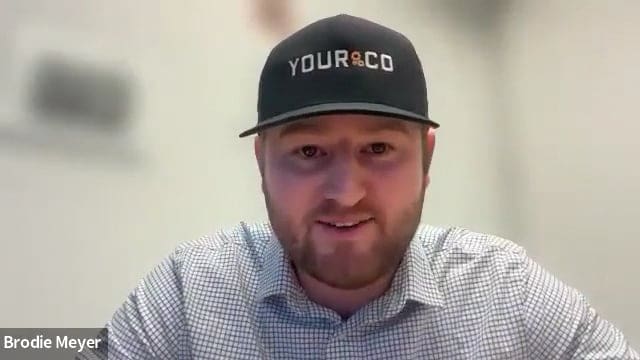
John LaRoy, CEO of Apparel Redefined, recently sat down with Brodie Meyer, the co-founder and CEO of Yourco, a company that is revolutionizing employee communication, particularly for non-desk workers. The discussion delved into Meyer’s background, his entrepreneurial journey, and how Yourco is bridging communication gaps in manufacturing and blue-collar industries.
A Dual Degree and an Entrepreneurial Spirit
Brodie Meyer’s journey is nothing short of impressive. Holding degrees in Economics from Butler University and Mechanical Engineering from Purdue, Meyer and his brother, Ben, have always had a knack for business. Their early ventures, such as selling bar crawl tickets and creating a bar specials app in college, set the stage for their larger ambitions.
After graduating in 2018, Meyer and his brother explored different business ideas before launching Yourco. The idea stemmed from a real-world problem—how to effectively communicate with employees in industries where traditional tools like Slack or email aren’t feasible.
The Birth of Yourco: Solving a Communication Gap
Yourco was initially developed to help Meyer’s family-run printing business, M&G Graphics, streamline internal communications. Traditional communication platforms proved ineffective for the company’s workforce, who either didn’t have corporate email addresses or were hesitant to download workplace apps on their personal phones.
Recognizing an opportunity, the Meyer brothers developed a simple yet powerful solution: a text-based communication system that allows companies to send messages in an employee’s preferred language without requiring app downloads. The platform quickly proved its value, gaining traction across industries, from manufacturing to construction and beyond.
Scaling a Solution for the Workforce of the Future
With an 80% share of the global workforce comprising non-desk employees, Yourco’s impact has been significant. The company now serves hundreds of clients, from small businesses to Fortune 500 enterprises, across the U.S., Canada, and the U.K. Meyer credits the company’s rapid growth to its commitment to constant iteration, direct customer feedback, and a deep understanding of the blue-collar workforce.
Venture Capital and Future Growth
Yourco’s momentum attracted venture capital interest, culminating in a successful funding round in early 2024. The investment has enabled the company to scale rapidly while maintaining its dedication to serving both small businesses and large enterprises. The company was even recognized as a Top 5 Future of Work startup at South by Southwest, further solidifying its place as a leader in employee communication.
Advice for Entrepreneurs: Use Your Luck
When asked about the best business advice he’s received, Meyer shared a powerful insight: Use your luck. He believes that every entrepreneur has a unique advantage based on their background, experiences, and environment. For Meyer, growing up in a manufacturing family gave him a firsthand understanding of the challenges faced by blue-collar workers, guiding him toward building a product that truly meets their needs.
Looking Ahead: A Vision for the Future
As Yourco continues to expand, Meyer remains focused on its mission: Bringing traditional industries into the future. With an unwavering commitment to innovation, the company is poised to continue reshaping workplace communication for years to come.
For more information about Yourco, visit yourco.io or connect with Brodie Meyer on LinkedIn.
Final Thoughts
Brodie Meyer’s story is a testament to the power of identifying real-world problems and creating effective solutions. From a simple communication gap to a game-changing platform, Yourco’s journey is one of persistence, adaptability, and unwavering dedication to serving industries that often go overlooked in the tech space.
Stay tuned for more inspiring conversations with Apparel Redefined!
Key Highlights
• Introduction and Background of Brodie Meyer 0:02
• Brodie’s Entrepreneurial Journey Post-College 4:51
• Challenges and Pivot to Yourco 6:45
• Customer Discovery and Early Adoption 14:08
• Expansion and Market Reach 24:47
• Future Plans and Vision 29:19
• Inspiration and Motivation 30:28
• Final Thoughts and Closing Remarks 35:02
Transcription
Curt Anderson 00:02
Hey, John Leroy, what’s happening, dude? What’s up? Curt, been a couple weeks. It’s been a couple weeks, man, we’re betting, you know what? And it’s good. We needed to take a little break because we have a powerhouse guest today. We need to get, like, our sleeves rolled up, ready to rack and roll so, man. Brodie Meyer, how
Brodie Meyer 00:18
are you, dude doing? Well. Curt, thanks for having me. Oh,
Curt Anderson 00:22
my goodness gracious. How you kidding me? So I’ve been all fired up for this for weeks, and so thank you for taking the time. I know you’re busy entrepreneur, entrepreneur, busy CEO. So let’s go here first. Okay, so being the overachiever that you are, most people like, just go to one college what give us your little college background? Would you please?
Brodie Meyer 00:44
Yeah, so went to Butler University, played baseball there and studied economics at Butler, but they didn’t have a engineering program directly at Butler, so they do have a dual degree program with Purdue. And I studied mechanical engineering at Purdue as well. There’s a five year program for economics and mechanical engineering, you know,
Curt Anderson 01:09
like, I barely got through, you know, I don’t know John. Like, I, you know, I’m like, I think I’m one of the all time, greatest 2.3 GPA college students ever. And then we get a guy like this, who’s like, you know, Mr. Show off here. What do you
John LaRoy 01:21
think? Yeah, I mean, that’s really impressive. I’m proud to say that you grew up my area, but that did not rub off. I’m
Curt Anderson 01:31
didn’t rub So, alright, that was a perfect segue for the next now, you guys grew up in the same neighborhood, just John. What’s like? Let’s, let’s go back in time, man. Little neighborhood connection here. What do you got? Yeah,
John LaRoy 01:43
old Payless. I mean, I was talking, I mean, crazy, you know, we’re at a networking event from my cousin who put it on downtown a couple weeks ago. And I gotta meet this guy, Brody, and we talk, and where are you from? You know, leads to a south side. Oh, really, where you at? And it’s like, forest view. It’s like, I grew up in Edgewood, you know? It’s like, you don’t know those street names unless you’re from that area. And it’s like, holy shit, you know? And who do you know? And then you know, his his wife is betting already golf, you know? It’s like, the world famous putters. And it’s like, my god, well, one of our customers sells the Betton already. So it’s just crazy connections. But yeah, I mean, old, palest heights. My dad, you know, built his or my grandpa built the house there in like 62 we bought the parents. Or my dad bought the house from his parents and grew up there. And yeah, great neighborhood, man. And it’s crazy, because it goes through those cycles of no kids, tons of kids, no kids, tons of kids. And palest as a whole certain sex, like the kids are coming back, because it’s just a great place to live. The wrap on it is that, you know, everywhere here it’s just really expensive to live, right? And most of those houses being built in the 60s, 70s, 80s, it’s time for some renovation, right? But the the initial purchase price. You’d think the House is already renovated, but it’s not, you know. So it’s, it’s, it’s kind of, you build or you just buy, you know. So I think a lot of people are building if they’re coming this far south, but, yeah, great spot to live, and just incredible that Brody grew up right down the street from me, and the whole area is built on, like, like, golf names, right? There’s a lot of golf and what’s crazy is, like, those two massive 36 hole golf courses that used to be there are gone, and it’s just housing, you know, it’s like, that’s where my dad grew up, like, being a caddy and going in the lakes and taking balls and reselling them to the golfers. And, yeah, there was West Gate. Was just a massive complex, and you wouldn’t even know it existed nowadays.
Curt Anderson 03:45
So, Brody, what, what were your thoughts when, John, when you’re making that connection there? I
Brodie Meyer 03:50
couldn’t believe it. I mean, it was a, like, a tech, like, networking event. And, you know, I don’t run into a lot of people from palest heights, let alone old west gate there. And, you know, talking to John is like, there’s no way we have so many connections. Growing up on the south side, I do. I need to make one correction on my wife, though it’s, it’s her uncle is involved in bat Nardi, the putters, but her whole family’s in manufacturing. Her dad runs a machine shop, and her uncles, and they’re all they’re all big manufacturers. Same with same with my family. My family. I’m from a manufacturing family as well,
Curt Anderson 04:31
absolutely. Well, hey, man, that’s music to our ears, because we’re all about manufacturing. That’s big part of our our our premise with the show, and just really hitting manufacturers and entrepreneurs. So let’s go here. So 2018 you get out of fresh out of college, Mister dual degree, Mister Purdue and Butler, just so impressive. Hats off to you, dude and so talk to us about, like, post college. How did you start your entrepreneurial career? Because I want to dive into you’ve got a wonderful company. Looks. So impressive your co let’s talk about that, that gap from college to the entrepreneurial journey, what made you start your business?
Brodie Meyer 05:07
Thank you. Yep. So my brother and I, we’d always done business related things. You know, we were always selling something in college, bar crawl tickets. We had a bar specials app in college that helped pay for a lot of bills. He studied Computer Engineering at Universal Illinois. And, you know, we kind of both naturally growing up. We’re attracted to technology and software and that that like tech world coming out of college, you know, we’re we had a few different ventures. And I’ll jump into the like the your co story, the genesis in 2020 we were building custom software for businesses, and basically Ben was our building, and I was selling and I was going out and meeting, you know, different businesses, mostly manufacturers, trying to understand their needs, and then we would take those requirements and build a custom tool. One of the companies that asked us to build something for them was the family printing business. My grandfather started a printing company in Chicago, these 40 plus years now old, and my my dad and my aunt currently run it, and my dad or my aunt runs human resources there. And she came to us and said, Hey, I know you’re building software for these businesses. I’m having trouble communicating with the folks on the plant floor, you know, the the laborers, the people, the Pressman, the folks in the warehouse. And, you know, could you help us build a communication platform for me to be able to communicate with those folks? And we said no, because there’s, there’s a lot of different platforms out there, right? Like, we use Slack, Microsoft Teams, like, there’s just so many different communication platforms for employees, and slack was working really well for us. So we said, hey, we’re actually going to help you implement slack at the shop. Went there and it it failed miserably. Um, we went and talked to the employees to try to understand, like, why is this not working? And majority of them, they didn’t want to download an app. You know that their employer was making them put on their phones. They didn’t have corporate email addresses. They didn’t pay for data plans. A lot of them spoke different languages as well, more of a, you know, blue collar setting, but what we did see was that they were on their phones during break lunch, you know, off work hours, and what they’re doing is texting, and they’re texting with their family, they’re texting with their friends. So we said, hey, we actually are going to build you something. We’re just going to meet your employees where their attention currently is, and we built a Slack type web app that human resources is able to utilize. Human Resources, managers, supervisors, operations. Sometimes it and the employees, all they’re going to see is a text message, a simple, you know, SMS from the company number we launch it there. It’s like, it’s like a light bulb goes off, all of a sudden, there’s like a there’s a direct digital means of communication. It’s happening in the employees preferred language. You know, what? If an employee Replies in Spanish, our AI language detection understands, you know, even the dialect, and it’ll translate it to English for human resources and management to be able to then read what you know, they’re trying to say and communicate back in English. And it translated to the preferred language of that employee. So, you know, that went really well there. But you know, we didn’t have a business out of it yet, right? It still felt like one of the custom solutions that we were building for companies. That’s when I went off and did a lot of customer discovery. Went to different manufacturing companies, some construction companies, trying to understand, where are you experiencing the same problems that our family printing company was experiencing, and overwhelmingly, yes, like, we just kept hearing the same problems over and over, and that’s really where, where things started to take off. So that the little, little nugget building, you know, helping our family out with that solution really helped us, you know, launch into, into where we are today.
John LaRoy 09:43
It’s awesome. I forgot to ask, or if I did, I forgot what is a family printing company
09:48
that’s called M&G Graphics, M&G Graphics, okay,
John LaRoy 09:53
3500 West, 38th Street. Okay,
Curt Anderson 09:56
so Brodie, I couldn’t love this story more. And the funny thing is, like, as soon as you said, Slack, I knew exactly what the where you’re going to go, but I just think, how many entrepreneurs, you know, like, you think, like the New York Times, best selling book, Lean Startup, you know, like they started here and found out, like, Nope, it’s over here. But what you did I get, I really hats off to you, because, like, you had the guts and the courage to be like, hey, you know what? There’s, there’s, let’s get a conversation going. Let’s get things going. Let’s get slack. Is going to be perfect. It’s already out of the box. You don’t have to pay for anything custom. I mean, it makes perfect sense on paper, right, right until, like, you get on the shop floor and everybody’s like, what? Like, I don’t know this. Like, I could just pitch. I knew exactly what was going to happen, right? But I love how, like, you guys weren’t deterred by that. You’re just like, oh, okay, well, this is a learning opportunity, and I think this is so valuable for entrepreneurs like, man, don’t get discouraged just because you run into a dead end. It’s just like, Okay, let’s find another way. So like, you kept your eye on the problem and just like, pivoted to another solution. Walk us through, like, I’m curious, like, how, like, how long before you had the light bulb? Of, like, hey, there’s got to be, let’s, let’s take a pivot
Brodie Meyer 11:09
here. I mean, it’s pretty immediate, because it just wasn’t working.
Curt Anderson 11:13
And the immediate, but the because you got immediate pushback, meaning you got immediate feedback, which is so phenomenal, so many entrepreneurs like, we’ll come up with a solution, and they’ll like, I know this is what they want. I know they want slack. And you guys reacted immediately, man, tell us more.
Brodie Meyer 11:32
Yeah. So you know, it was like, Okay, well, what do we how do we simplify this? Because nobody wants software that’s complicated and difficult to use, and what’s the easiest possible thing we could do? Well, we don’t want downloads. We don’t want any cost to anyone for using it, you know, note, so we don’t want data to be involved. We want to build this super quickly so we can continue to iterate and see okay, if this works or doesn’t work, we’ll know immediately. So keeping that quick feedback loop, and that’s when it was like, alright, you know this, this is what we have to go. Here’s the simplest way to build this thing. So it really started with a small, you know, solution that solved the problem, but it’s grown into this thing where we’re now able to serve, you know, still small businesses, but also four to 500 enterprises. Um, we have hundreds of clients now across the US, uh, Canada. We’re launching in the UK this month, and we’re getting pulled into, you know, really, the global economy, there’s, we have a lot of clients that are serving, you know, they have different locations all across the globe. So it’s really been cool to see us transition from, you know, a small business solution to we can fit the needs of these large enterprise clients from an integration perspective, translations perspective, you know, being a global company, you have to be able to manage all the different languages, security, you know, like we’re having these. We have these. It reviews with a lot of, you know, larger clients. It’s a it really, over the last four years, it’s really been a level of sophistication that we’ve had to level up to because we were mostly serving small businesses, and now we continue to serve a small business, but also we’re able to bring all that functionality that the large enterprise customers want, and we’re able to bring it back down and really provide some powerful functionality for these for small businesses as well.
Curt Anderson 13:40
Dude, I couldn’t love this more. John, so All right, let’s go here. Okay, so you’ve, you’ve figured out for take the pivot slacks not working. Was it a big lift for you guys to customize, or was it was that kind of in your wheelhouse to create this custom solution that was in
Brodie Meyer 13:55
our wheelhouse? I mean, what we’ve done, I don’t know when we started building software, but it’s been a it’s been a long time. So at the moment, it was just like, here’s the specs. Let’s let’s build it and let’s implement
Curt Anderson 14:08
Okay, so brilliant. So you guys solve the problem yourself. When did you make the transition to like, hey, if this works for our family’s printing business, what was who and what was customer two? Like, what did it look like we’re going to replicate? This?
Brodie Meyer 14:23
Yeah, so first it was, you know, I was doing those customer discovery calls, but how I found customers initially was cold calling, LinkedIn, emailing, just networking, just grinding it out to try to find other folks that look like our family, printing business. Then, you know, got a few, probably the first 510 customers. Really got them up and running, really stayed close to those clients as well, like, because they were just able to give us feedback on feedback on feedback, and we’re able to produce an even better and better product and event. Really, like one of those early customers. They got us in front of Sherwin Williams, and you know, then we then great. We had some network effects happening. We had some good referrals from our from our clients, because they were enjoying the experience, enjoying the product, yeah, and then it just kind of kept going from there, like, you know, to this day, we still do a lot of outbound, you know, cold calling, emailing, trying to find best fit customers, but also there’s a lot of customer referrals that happen. I think that’s another really interesting thing that we did early on was, you know, we built other software platforms in the past, and what we really wanted to understand was, are we providing true value to our client? And the way we’re able to determine if we’re providing true value to the client is, let’s keep everyone on month monthly plans, and if they cancel at the end of the month, you know, we obviously didn’t prove our value within the first 30 days. There were no cancelations like it. Just so we were like, Okay, we have something here. Now. We do annual contracts, multi year deals with with larger businesses. But like, that was a really good point for us to try to understand, are we actually providing the value we think we are to these customers, and we have to do it within the first 30 days. And it really pushed us, right? I mean that that, that really pushes you to have to, you know, if there’s something missing that the client tells you, like you need to fix it immediately, or else they’re not going to, they’re not going to renew with you. So that was a big key to understanding the product early on.
Curt Anderson 16:40
All right, John, what’s your takeaway so far?
John LaRoy 16:43
I just, I pulled up as the M&G website, and I’m just, I have so many questions, because, just from a dad perspective, right? You know, I’m trying to build something that I want to give my kids the opportunity if they want to take it to the next level or continue with it. I guess at what point did you and your brother realize, like, I want anything to do with this, I start my own thing, and being in printing, right? Like, even though we’re similar industries, different media type, different that, I feel like the lack of innovation in both of the industries, for a long time, it was just you did it this way, and there wasn’t much tech involved. Your parents would look like, starting in 84 I that probably shaped. I mean, obviously the mechanical side, being around the machines and all that type of stuff, definitely, probably had an influence. But then also from a tech side, of like, hearing probably, like, just gotta be a better way to do this. And, yeah, it’s really cool. I would probably influence too, but also too, and I’d love to continue conversation offline, but we just, I just got back from Phoenix, from a print on demand conference, and like, looking at these traditional applications and how they’re being kind of forced to go to on demand, where, like, you wouldn’t do minimal order quantity one, especially in, like your in your parent setting, and then you talk to, like a cut sew facility that is somehow doing minimal account quantity of one on like shower curtains and bed bedding, and, you know, even all the way down to, like, custom polos. So it’s super interesting. And like the tech, it’s not the equipment, it’s the tech that’s driving it. And the less touch points, the easier it is to get all that stuff done at a profitable at a profit margin. That makes sense for everybody. But yeah, it’s super cool. Yeah, so my takeaways are a little bit different. Curt, but yeah, just amazing too, because to tie it back in Slack, right? You know, we didn’t before slack. It was, was it Google Hangout or chat or whatever and stuff would just get lost. And it was, it was a nice way to interact with the people that were on a computer, but we needed something more to get down to the floor level. And slack is, unfortunately, well, we took took up, but there’s so many things that there’s gaps and they you didn’t, we didn’t meet us yet. I didn’t know about No, we should. We should have met. I think you’re probably still in high school, but that’s okay. But, yeah, no, it’s interesting, because that level of communication, especially, like in manufacturing, Curt, like, again, all Brodie’s connections, his parents connections, like, inside the manufacturing space, like we talk about, like one of Curt, big thing is stopping the best kept secret, right? You know, like so many people like you’ve been around, all you do is work. You don’t like talking about yourself. You don’t market because you don’t want you know it’s just like it’s a thing that you don’t do. You just do really good, you service your customers and kind of shut up. And then what Curt has been helping me with is starting to tell people what we do and bring on some marketing. But so much of that. Missed because the manufacturing is so time intensive, right? There’s the focus of the American economy is not go hire more people, you know, and manufacturing, you need that. But then how do you communicate with all the different languages and dialects and all the different cultures that you see, especially in big cities like Chicago, and that’s a great, great way to solve a very worthy problem that needed to be solved. So yeah, hats off to Matt’s awesome.
Brodie Meyer 20:29
Thanks, John the you know, can this be done a better way? Like, yeah, we I’m from a blue collar family, right? And so obviously, very, very close to my heart. Our vision, your goal, into the future, is bringing traditional industries into the future. So you know, this is a great this is our flagship product. But like you said, there are so many problems within manufacturing, construction, transportation, AG, hospitality, rebuilt that that like could utilize really solid technology solutions to help advance both the organizations and the industries. So we are very focused on, you know, helping and serving this, this segment, which, by the way, is 80% of the global workforce is the non desk employee, right? So, and I think we to your point about, like marketing. I think a lot of software businesses and tech businesses, they do, they are very good at marketing, but they’re marketing to other software businesses and tech businesses. So we kind of lose sight of, hey, look at the industries that are actually driving the entire employment for for 80% of the world. Just find that interesting.
John LaRoy 21:50
And 80% of that’s 80% of the global workforce too. Like, I would say a significant part of that workforce can’t be replaced with AI. Like, yeah, you can’t replace an electrician with AI right now. You know what I mean, like potential products and stuff, but all of those really necessary jobs that aren’t being, I don’t say, catered to, but actually considered, when most of the software that you see out there is not built for that level. It’s built for managerial and above, right? And everyone else just kind of like, Hey, you gotta deal with it. Like you don’t even get a company email address where we’re just, we’re just gonna connect you via via text, and now that makes it okay. Yeah, it’s awesome.
Curt Anderson 22:36
Yeah. I think John, this ties in so Brodie, one thing that John preaches, and what I love, and I’ve learned from John is he talks a lot about what, what’s called the brand promise. And I, you know, when I’m as, I’m listening to you talk about, like, your solution, and it was you and your brother, Ben, is that what you said? Right? Right? Yep, you know. And just when think about, I mean, it’s really a cause so much bigger than yourself, or just like, you know, you and Ben, like, you know, hey, we’re, getting messages out on the floor, like, you know, you know, you can talk about, like, HR, you know, health insurance sign ups, what’s for, you know, hey, we’re doing a company lunch or, you know, those types of things. But I mean, like, the brand promise of, like, really, that cohesiveness of communicating with your customer, with your with your customers, your employees, and treating in I’m reading a phenomenal book right now. It’s called unreasonable hospitality. And it’s talking about, you know, like, how companies really elevate themselves in, like, really focusing on their customers first. So the whole time that you’re talking, I’m like, you’re delivering such a powerful solution for the employer that cares, you know, and they can deliver positive messaging, inspirational messaging, or like, you know, company mission, or like, hey, that a boy, that a girl, to folks on the you know, and I’m in and out of manufacturers all the time, and you’re 100% right, like, they’re on their phones. And so what you’ve done is you, you bridge the gap where the manufacturer or the entrepreneur wants to communicate with their team couldn’t quite figure it out. And you and Ben just figured out that there’s a seamless solution, dude, it is absolutely brilliant. When Now you talked about Sherwin Williams, and you talk about, like, early stages, when did you and Ben look at each other and say, like, I think we have a scalable, like, we have a proprietary product like, this is scalable that we can take to other companies. Do you remember that day? Was there a moment like you guys looked at each other like, do you remember that at
Brodie Meyer 24:25
all? It was probably at like, customer 10, between customer 10 and 20, it was just like, okay, not only are we solving these problems, but these people just they want more and more and more built on to this platform, and they’re using it every single day. You know, from like you said, HR related things, but also critical, you know, emergency alerts. You know, we’ve had a lot of folks that sign up during the the hurricanes this past year down south. They utilized us because everything else went out but your co. Of us was was working. So they used us to make sure that employees were safe when there was fires in Hawaii. We had some construction companies on the West Coast using it to communicate with their employees in Hawaii. So, you know, emergent, it was starting to be used for emergencies, being used for day to day to day communications, like an employee calling off sick or something. Our system routes it to all the correct people. You know, they just text the company number, and then it’s, it’s known within the company by the by management, and they’re able to fill those positions. So there’s what we’ve seen is that a company will come to us for one use case, like they’ll have some specific use case in mind. But then after they use it, they’re just, they’re like, this is the most effective means of communication we have, and they start to use it for, you know, we do track use case every, you know, all the feedback we get, we’ve tracked over 1000 use cases over the Oracle platform. So really, we’re just giving you a effective means of communication, and then letting you go wild with it, um, yeah, with how you use it. Well,
Curt Anderson 26:07
I love and I’m like, Man, I’m old enough to be both your dads, so I’m way before your time. I’ll go back in the 80s. I vividly remember, like it was yesterday there was a TV show, and there it was a, you know, guy on a cell phone. You know, it’s probably like the big old bag phones or whatever they were back way before you both your time. And the guy was, like, you know, these cell phones are becoming a necessity, not a luxury, you know. And like, today, and like, it was so ahead of its time, because, like, when he said that you’re like, like, what you know, and like, now, like, can you imagine, like, you know, like, we can’t breathe if our cell phone isn’t near. But like, if you, if you misplace your cell phone, like you’re freaking out, right? And what you’ve just described Brody is like, your service is no longer a nice to have when you saw, like, a flooding and everything that went on in hurricanes, we’re like, they need to communicate with employees what we saw with the fires and, you know, like these tragedy, you know, devastating, you know, acts of God type situations that people aren’t prepared for. Like, you know, you’ve got, you’ve created, created a solution to communicate with everybody immediately. So kudos to you, dude, man. This is exciting. So let’s go here. What does, what does, uh, 2025, what are you guys super excited about for the future? Where’s the company going? What’s ahead of us?
Brodie Meyer 27:17
Yeah, so our, the type of customer that we have consistently served has been small business, mid market, type company, like that. That’s a majority of our clients. But we really started to dive into the last year, into large enterprise accounts, while continuing to service, you know, small businesses, we have a we have a free product that small businesses can sign up for right off the website. And what’s really exciting to us is, like, we have this team in place now, both and from an engineering standpoint, sales, marketing and support that like we’re able to serve these larger clients. We’ve done a few implementations already this year, and some towards the end of last year, where, you know, we’re not only providing value to the, you know, 20 to 1000 employee customers, but we’re providing value to the 10,000 plus, right? So I think what’s super exciting to us is we, while we continue to go up market and serve more technically sophisticated needs in enterprise clients, we’re also able to continue to service the small businesses and the mid market clients that where we started. And every time we add new functionality at the top of the market, we’re able to bring it down right to help better serve even these small businesses and mid market clients that didn’t know it was possible, like some of these things that they’re able to do with the system now. So I think that’s the to answer your question, like, that’s the that’s the most exciting thing. It’s like this march that we’re all taking as a team, and it’s the feedbacks been tremendous. You know, we did a round of we did a financing round back in end of 2023 beginning of 2024 is when everything kind of closed up, and we were in a position where, like the business was in a good spot before raising any sort of venture capital. And we got nominated by this event South by Southwest in Austin, top five future of work, technology or startup, and went down there and pitched, and like, you know, we didn’t know if we wanted to really go down the venture path, but we had a lot of inbound, you know, investor interest, and found the right partners that we’re, You know, really excited about getting involved with. And now it’s like, when you take on that venture capital, you’re still like, it’s, it’s business as normal, if you if you’ve been building the business the right way. But it’s also like, Okay, you bored now, and you have these management controls in place, and you’re. Really, it’s pedal the metal, right? Like they really helped us to understand how large the market actually is. So what’s exciting is the is the journey now, it’s the journey of how fast can we actually scale? And you know, it’s been going well. We every, every single month. Last year was the best month we’ve ever had. And actually, February, we just closed. It is the best month we ever had. So it we just have to continue that, that pace, that trajectory, and continue to accelerate.
John LaRoy 30:29
No pressure,
Curt Anderson 30:33
no pressure. What’s alright? We’ll start winding down here, buddy, I know you’re a busy guy. Man, just curing all sorts of problems around the world. What is your inspiration? What’s inspiring, you man, like, what’s driving you to, like, build this company.
Brodie Meyer 30:48
You know, I always knew I wanted to be involved. John said something earlier about, like, you know, why did we not get involved with, you know, the family business and, like, I always knew I wanted to in some way, shape or form. And like, that’s, I had other internships at other, you know, manufacturing companies, a chemical plant I worked at, and I’ve always been very excited about businesses that are building something or making something, or producing something or serving something, like that. It’s really exciting to me. But I also wanted to be involved. Wanted to be involved in in technology, because I think that’s where a lot of my expertise, or a lot of my desire, you know, was to go into tech. So how do I get how do I merge the two, right? And this was it. So, like, it’s just, like, it’s a it’s a calling, I think, for the rest of my life, like that vision that I said, bringing traditional industries into the future, that’s that’s all I want to do. And it’s really when you have that type of conviction and like, heart tied to what you’re doing, like, you never stop. It’s just exciting. You wake up in the morning pumped about what’s going to happen today, even though we all know as entrepreneurs, there are really low days, there’s high days, but there are really low days, it helps you continue to push through and continue to drive and accelerate. So I think like growing up, where I did, how I did in in this, you know, more of a blue collar family that these are the types of people that I always want to serve. Yeah, I hope that was helpful and understand
Curt Anderson 32:32
man, I tell you, are so wise and humbled beyond your years, man and mature behind your ears. Just so impressive. What a privilege, what an honor to have this conversation. John, your takeaways from our chat with Brody?
John LaRoy 32:45
No, yeah, it’s incredible, really cool. And again, I think that there’s a lot of a lot of stuff in software too, where, like, there’s so much out there. It’s unbelievable. Like listening. I was listening to my cousin and the guy at Ivy ventures, at the networking event, and he’s like, he’s hearing 2500 pitches a quarter. And it’s like, oh my god. Like, there’s that many soft and he’s just one guy, and, you know, one venture venture capital firm, and you know, there’s 1000s out there. So it’s like, it’s unbelievable that there’s that many people out there that are like, 100% convicted that they have or convinced that they have the solution that everyone can’t live without. But really, there’s only a special few that actually do solve that. And I think you really do have some there, Brody, and it’s really cool, and just having, like, a grounded background in the blue collar space, I think, is such a, such a unique advantage where, you know, you see, especially in software, like all the founders and tech that actually haven’t really done much, it’s just they create, look for an exit, get out. Create, look for an exit and get out, and you just have this iteration of patterns, of, you know, they’re advancing their career and advancing but like, what is the product, and is the product actually helping? Because, like, for us at the bottom, we’re, you know, we’re, I was just at this, at this print on demand conference, and this guy had a really good analogy. Or he’s like, you know, we’re screen printers. We’re the guys that were like, mushrooms. We we thrive on the in the dark, and we eat shit. And it’s, you know, and it’s like, Oh, my God, that’s I had a different way of describing it, but it’s like, it’s exactly what happens, and for us as a manufacturer, like, there’s so much tech and now stuff out there that wasn’t there 1510, five years ago, but you see, like, what happens? The ones, okay, we really like this platform is great, and then it gets sold, and then it becomes part of Salesforce, and then it becomes part of this and becomes that. And it’s like, Well, what I liked and what it took two years to get everyone to freaking use is now gone. And they don’t care because they made their exit. But like, well, the ones are actually using it the ground level you get affected. So, yeah, it’s crazy, long story short, really, I second everything. Curt said, humble and wise beyond your years. And keep going, Man, that’s awesome stuff.
Brodie Meyer 35:20
Thanks, guys. I appreciate it.
Curt Anderson 35:22
So alright, Brodie, we’re going to close out, dude. I have one last question for you. So you launched your business in March of 21 if I’m not mistaken, right? Was it March of 21
Brodie Meyer 35:31
Yeah, in March, March, April 20 so you’re kind of,
Curt Anderson 35:33
it’s a little bit like a COVID baby, if you will. If I’m not mistaken, that’s the COVID baby, right there. So you and your brother, Ben, you start this business young age for entrepreneurs out there, and I’d say, like, what you’ve accomplished in such an early stage of your career, my hat’s off to you again. Just so impressive, just a privilege chatting with you. For other young entrepreneurs, or even seasoned entrepreneurs out there, what is the best business advice that you’ve received in your entrepreneurial journey? What’s the best business advice that you feel that really helped you build your code to what it is today?
Brodie Meyer 36:10
You know, I don’t know if this is very traditional business advice, but someone told me one day, Mike Kelly, actually this guy, Mike Kelly, in Indianapolis. He’s involved in the in York COVID business as well. Early investor, use your luck is one of the things that he said, and that actually helped me really internalize, like, what I want to do for the rest of my life as well. And kind of along this path, trying to figure out, Hey, who do I want to serve? What solutions do I want to bring them? My luck is that I was born in a manufacturing business family, right? Like, like, a blue collar family and like, it also made me realize, like, you’re, everyone has has luck. You just have to, like, understand what it is, and you really have to do some deep diving into yourself and understanding what that luck is, because that’s going to be your best path towards success.
Curt Anderson 37:13
All right. That was brilliant, absolutely brilliant, phenomenal. Use your luck, John, I think that’s going to be our next round of T shirts are going to be use your luck. We’ll put Brodie, you know, we’ll reference you, bro so we got you back. Uh, perfect. Anyway, I want to, we’re going to close things out, Brodie, where can everyone find you? I know you’re you’re all over. LinkedIn, we can go to your website, just share with folks where they can find you. We’ll have it in the links, in the in the recap. But just where can people find you? Yeah,
Speaker 1 37:42
LinkedIn is great. Google, Yourco Our website is yourco.io, other than that, on LinkedIn, a little bit of Twitter, but LinkedIn is better for
Curt Anderson 37:59
right dude. Well, hey, I’m looking for you on the cover of Wall Street or fortune and so, like, and when you when you like, when you make it you know, like, huge. Like, don’t forget the guys that you know, that you know, kind of like us little people, when you make it really big, right? Don’t forget us little guys, right? So that’s
Brodie Meyer 38:14
the, that’s the point that never will, that’s the point, you know, that’s
Curt Anderson 38:18
right. Well, I, I commend you. Your blue collar roots are just shining through and just do me a favor, tell mom and dad, they did an amazing job raising such a wonderful son, because I tell you, you are an absolute delight to talk to. I learned a ton. I’ve been taking a ton of notes. I’m probably twice your age, and this was like a master class for me. What an honor, what a privilege, John, thank you for setting this up. Another just dude, week in, week out, man. I just, I don’t know how you do it, but you just pull off these amazing entrepreneurs. And it’s just such a blessing to learn from people like Brodie. And I just, I hope the apparel redefine crowd. Just loves listening to these guys, because I, I’m telling you, it’s inspiration, it’s lessons master class of like, successful entrepreneur. So Brodie, we thank you. We appreciate you. We wish you just massive success with everything you do. Keep firing in all cylinders, man. And can’t wait to see you down the road. Okay,
Brodie Meyer 39:12
thanks. Curt, great to meet you. John. Good talking. Thanks for, uh, thanks for having me on the show. Appreciate
John LaRoy 39:16
it. Thanks for jumping on,
Curt Anderson 39:18
man. Alright guys, we’ll catch you next week with another wonderful I don’t feel as amazing as this guest, John, I’m sure you’ll, you’ll, you’ll do your best to get line and line it up. But this was a wonderful conversation, so we’ll see you guys next.