Grow Your Brand and Build Trust on LinkedIn
If you run an apparel company and want to grow your business, LinkedIn is the place to be. It’s more than a resume site—it’s where smart brands build trust and find new customers.
Here are the top LinkedIn strategies to help you stand out:
1. Create a Strong Profile
Your profile is your first impression.
Use a banner with your logo
Add a clear, friendly headshot
Write a headline that says who you help and how
In the “About” section, explain the problem you solve
2. Share Helpful Posts
Posting on LinkedIn keeps you visible. Use the 80/20 rule:
80% educational or helpful
20% about your services or products
Example Post:
➡ “Here’s how we helped a youth team get custom uniforms in just 7 days!”
3. Use Visuals to Grab Attention
Photos and videos stop people from scrolling. Even fun or inspiring images can help. Pair visuals with helpful info for more engagement.
4. Be Social
Don’t just post—connect! Comment on others’ posts, answer questions, and start conversations. This builds digital trust.
5. Start Today
You don’t have to be perfect. Just be helpful and show up. That’s what makes these top LinkedIn strategies work for apparel companies.
Key Highlights
• Introduction and Initial Greetings 0:02
• Damon Pistulka‘s LinkedIn Journey 0:41
• Curt Anderson and Damon Pistulka on LinkedIn Best Practices 2:35
• John LaRoy‘s LinkedIn Profile and Digital Trust 5:01
• Damon Pistulka on Building Digital Trust 7:43
• John LaRoy on LinkedIn Posting Strategy 9:24
• Damon Pistulka on Content Creation and Engagement 12:36
• John LaRoy on Relevance and Engagement 14:54
• Final Thoughts and Encouragement 17:48
Transcription
Curt Anderson 00:02
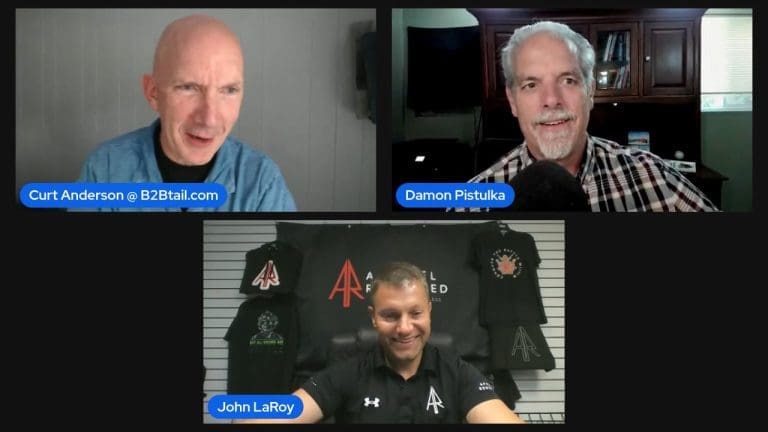
Hey guys, hello there. Welcome to the show. We’ve got, hey, my dear friend, the the one, the only, the CEO of Apparel Redefined we’ve got John. Leroy, John, how
John LaRoy 00:11
are you, man, I’m doing great. Curt, how are you? Oh, my goodness
Curt Anderson 00:14
gracious. I’m doing absolutely phenomenal. And we’ve got a really special guest today, my co host with the most this wonderful human being. Damon Pistulka, Damon, how are you,
Damon Pistulka 00:24
dude, I’m doing great. Curt, happy to be here.
Curt Anderson 00:27
Awesome. I can tell I can just like, I can feel the energy coming right through the computer. Dude, like, just, hey, maybe you need to, like, settle down. I’m just kidding. So I will, let’s, I will, let’s, let’s talk. We’re going to geek out. We want to talk about, you know, have you heard of this social media platform. It’s called LinkedIn. Have you? Have you done anything with LinkedIn?
00:45
I’ve, I’ve heard of it. You’ve heard of
Curt Anderson 00:47
Okay, now just talk to us a little bit about your journey. I’m gonna pull up your profile in a second here, talk to us about your journey like before. In all seriousness, you got on early. You’re an early adapter, but you weren’t really active, and then you flip the switch, and you really have figured out LinkedIn. Just share a little bit on your LinkedIn
Damon Pistulka 01:05
journey. Yeah, well, I mean, I, I think I’ve started logging in and set up my account on like 2005 so it’s been over 20 years now, and really, in the beginning, it was just like everyone else. You just kind of put a little bit about your resume on there, and that’s all you do. And fast forward into starting different businesses and doing things. I started to build my profile a little bit more, but it was really in 2015 when I started to see how it was being used. Microsoft had just purchased it, I think, recently, at that time frame and and really started to be more and people wanting to hear this, but it’d be more Facebook Like, where you have people actually posting things on it. Because, you know, 1015, years ago, there was very little posting at all going on LinkedIn, and I started doing a little bit of it. It was probably six, seven years ago, eight years ago, I started posting a little bit, and then I just continued to do that. And then in 2020, and all the time, I was kind of, you know, researching profiles, seeing what the people are doing, seeing what people that at that time, even that had, you know, hundreds of 1000s of followers or or at that time, connections, or followers, or whatever they could do. Oh, in the old days you could only have 30,000 it would stop. But then it changed so you could have unlimited but, and continue to post more, continue to build more community, and, and that’s kind of got me to where I’m at today. Yeah.
Curt Anderson 02:40
So let’s, I’m gonna, if you don’t mind, I know you’re a humble guy, but I’m gonna pull up your profile so, you know, here’s our dear friend Damon Pistulka. Strongly encourage anybody out there listening, follow Damon on LinkedIn, while you’re at it. Follow our dear friend John LeRoy on LinkedIn. I would love for you to follow myself, Damon. Let’s talk a little bit about, you know, you got really intentional here. You’ve got over 90,000 followers on LinkedIn for friends out there in the apparel industry. You know, this is really the place to be for B2B. Let’s give us, like a little one on one overview. What are some things that they should have on their profile? Just some basics. You talk a little bit about the banner, like you’ve got your QR code headline. Let’s, let’s cover some of the basics here.
Damon Pistulka 03:21
Well, first of all, you know, get a banner image. Hey, hey, just don’t let it dead space, whatever they put in there from LinkedIn. I mean, because you gotta that’s, that’s a first place you should do at least logo or something else. I suck the QR code in there because I thought it would be interesting to see how many people could actually go to a website for the QR code. And I get a few that that, you know, make sure you got a decent headshot too, you know. And that’s it’s doesn’t have to be in a suit or anything like that. Just has to be clear. Gotta be able to see who it is and do that. But I think that, you know, looking into the text the the headline is where I was always hosed up on that, because your headline really should tell people what you do and and the benefits you provide, because if it says CEO at, or says engineer at, it’s not really doing you that much good salesperson at, you know, people want to know what you’re doing. You’re helping, like in, you know, I’m, I’m helping, helping athletic clubs put cool clothes on their kids, you know, something like that. You want that kind of thing showing up in there. So that’s the first thing, is really, really speak to your audience with your headline, because that’s what’s going to show up everywhere. Well, I
Curt Anderson 04:38
think that’s phenomenal advice. And we always talk about, you know, when you try to be everything to be everything to everybody, everyone, you become nothing to no one. So you’ve really niched down into your space. John, anything that you want to chime in. As far as you know, we got you going on LinkedIn, anything that stands out to you. So far what we’re discussing,
John LaRoy 04:56
I gotta update my headline. I. He was talking. I’m like, scrambling to look. I’m like, Oh God, do I have a picture here? And then my he I thought Damon was reading my profile, because it says CEO ads. I’m like, Oh God, this is bad. So, yeah, I definitely need to update the LinkedIn profile. We are nowhere near, anywhere close to the journey you guys have been on in LinkedIn. I think I, you know, started my my profile, and I think it was blank for maybe 10 years. I just had it because that’s what you do. Really nurture it or take care of it. I also didn’t understand it, you know, and also the fact that, for the better part, the vast majority of my business. We weren’t marketing. And Curt, you’ve helped me kind of climb out of my own head, right where it’s like, you know, and my grandpa used to say this all the time, like, tell the world what you’re doing, and that would, they didn’t have this, you know, it was more of a pickup going to phone book and call. And my dad, my grandpa, were natural born salesman. And for me, it was always like, well, I’ll feel comfortable telling people what I’m going to do when I have something worthy to show, right? And it was just like, Well, you do. And I was like, Well, I think it could be better. You’re never going to not feel that it could be better, right? But to build that digital trust. Curt, we’ve talked about this a lot, right? You know, when we wanted to kind of peel back the Curt and show people what we were doing. That’s great. And when we wanted to get into other verticals and other client spaces, if you don’t have that digital trust, if you don’t convey who you are and what you are digitally, you lose that opportunity. You know, like people want to say, stereotyping is not real, but you really got, you know, less than a second of actual personal, personal time to make an impression digitally. It’s probably even less than that, right? If you give it an opportunity to someone and drag them to your website and they go verify you on LinkedIn, if it doesn’t look cohesive, one and two active, you’re not going to you’re not going to gain that trust, and potentially you’re going to lose a customer. Then they’re going to go to someone else that makes them feel safe, makes them feel Hey, this is a reputable company. Is that with that deal with that B2B, B2C, marketplace is becoming more and more digital. There’s less and less I’m saying this like this is completely personal, but less and less face to face business. So your face to face is is that digital trust, and if you have a hard time conveying that because you’re not doing it, then that’s kind of on you. And I appreciate Curt and Damon, you guys kind of saying, hey, instead of pushing me along, pulling me and saying, You gotta do this type thing. So I gotta update the my headline. I’ll do that.
Curt Anderson 07:37
Well, I love it. So Damon, your thoughts, any, any response to John, I
Damon Pistulka 07:43
understand completely, you know, coming from the sales. You know, I was back when I was selling molded products, back in the in the 90s, you know, it was, it was all driving and going and meeting people, and I had to convert out of this as well and really understand what digital trust, how you could build digital trust. And as I got started on LinkedIn and really, and then the live streaming and the other things that I was doing in the videos, you really begin to see how you can do that by sharing thoughts, commenting on other people’s posts, if they’re posting stuff, and really being honest. And what you find is, over time, people will get familiar with you. They’ll they’ll find if they like you or not. And it’s, it is a pretty natural process. Yeah.
Curt Anderson 08:31
So now we talked about the banner up here. We’ve got the headline, nice, handsome picture. Now you make it easy, Damon, as photogenic as you are. Now we scroll down here and we look at the about section. You know, one tagline, John, that we love to share with folks is like, how do you out teach the competition? Sort of thing is, what if you’re stuck here, if you’re struggling on like, hey, what do I put here? Man, just think about like, what’s the problem that you solve? Who’s that ideal customer that just loves you, worships you, just you know you they love the tshirt, the hoodie, the whatever product that you’re putting out for them that you know, and put that in your about any tips advice that you have here. Damon, as far as the about section,
Damon Pistulka 09:09
it’s, it’s like you’re saying you really want your about section to have a nice, nice hook statement at the top that’s going to grab someone’s attention about the exact kind of problems you solve, because there you got a lot of room in this section. But if they don’t hit the more see more you don’t, you don’t get anything out of it, right? So that that first couple of lines has to be really compelling, and then you can add the other things down the page, and you know the specific problems to let them know, you know, where they’ve been and and really, and you’ve helped other people do that,
Curt Anderson 09:46
right? And, you know, I love what you have here. You know, is your business stuck in neutral. So you’re asking the question, so, yes, my business is stuck in neutral. You know, sound from you know, you’ve built a business success, but lately you’re feeling stuck. Does that sound familiar? That’s where I come in. So like, you’re, you’re being very concise on, like, this is the problem, if you need operational excellence, or, you know, HR, you know, like, I’m probably not the best fit for you. But, man, if your business is stuck in neutral, you’re looking for growth and exit certain, you know, certainty, you’re the guy to go to. So John, anything that you want to chime in, as far as the about section here for our friends out there that we’re looking to help build up their LinkedIn profile,
John LaRoy 10:26
no, I think the the leading with a question, right? You know, I feel more than ever, at least, in my opinion, were LinkedIn like Facebook and LinkedIn, right? They started for two different purposes. Facebook was just like collegiate networking, right? And sharing pictures with friends. No one thought eventually you’d be able to sell an old toaster or a VCR on there, among all the other things you could do on there, right? And I feel like, within the last probably 36 months, I feel like LinkedIn, in my opinion, has become very more salesy, right? You know, you get hit. You get hit, especially the more active you’ve gotten, which I have definitely but you get requests for connections all the time you get, you know, I use it as a sales tool to try and connect with people that are somewhat second or third connections with me. And when you do, and you do get that, you know, acceptance for connection, or whatever they call it. You only got a couple seconds again. It’s that digital trust. Okay, this is a real person I do know, or I don’t know what parallel defined. I do know, or I don’t know, and you’re kind of going through these visual but also mental checks, the visual I know, the mental, hey, he’s connected with me over here. What does he do in those first three or four lines, does he solve a problem I’m currently having, or or not, and then, if not worthwhile, to connect with this person, because it’s going to help my business, or, you know, my personal relationships or whatever, or my network. So yeah, those first three or four lines after that, after the visual checks that you’re, you’re kind of subliminally going through, will make or break that be an impactful connection or not, in my opinion,
Curt Anderson 12:06
totally Damon. Any thoughts that you want to add on to John? Because next I want to talk about, I know we’re a little tight on time, but I want to comment on a couple of posts. Anything that you want to add on that John just added?
Damon Pistulka 12:17
No, I think he’s right online. Yep. Alright, perfect. Let’s Alright.
Curt Anderson 12:21
So we’re talking about your profile having a nice banner, strong headline, really being intentional with the about section and Damon, one thing that we love to preach is like, don’t make it about yourself. Make it about your ideal customer. We call them soul mates. So what’s in it for your soul mate? What’s the value that you bring to them? Let’s talk about posting. You do an amazing job. You post seven days a week. You’ve built up this incredible community, vibrant audience of 90,000 plus. Talk a little bit about your philosophy and your approach with your posts here,
Damon Pistulka 12:52
wait, you need to, I think you need to be intentional with your posting strategy, what you want to be talking about and what you want to be sharing, because otherwise, you’re just out there yelling right, or whatever you’re you’re in the middle of a field screaming right. And so you want to understand what, what kinds of content people that your soulmate customers really enjoy, both from the fun standpoint, and then from practical standpoint, things they can learn things they should think about, and then, ultimately, too, a little bit of what are some things that you do that could help them, that you might spark a sales conversation. So it’s not just one, and I like to use 8020 rule. 80% of it is is helpful, educational fun. 20% of it’s going to be more sales focused. It’s going to talk about this is something that I could help with. This is something that we may want to talk about and really do it that way. But in the end, you have to be watching what what’s happening. How many, how many comments are getting, how many likes are you getting, and what time of day you’re posting, but the contents really important is to keep the content coming that your audience really enjoys. Yeah, and I
Curt Anderson 14:09
love, what a great segue here, because we just mentioned, you know, I’ll teach the competition. You’ve got to post right here, talking about, you know, right here. You know, the best marketers aren’t the loudest, they’re the most helpful. So again, if you just dedicate yourself to be an unapologetic educator, how to help your ideal customers, those soul mates, move the needle. Now you’ve, what’s interesting is you post a lot of videos are very inspiring. You’ve got videos like Steve Jobs here. I know you’ve got another one down here, of like Tony Robbins. A lot of inspiring type things. What’s just again for somebody that’s kind of new, or maybe they’ve been on LinkedIn, but they want to take the next level, as you have, what’s some advice you have as far as, like videos, posting these images, these little quotes that you have, anything that you want to share there?
Damon Pistulka 14:54
Well, I think really what we’re trying to do is we’re trying to gain, as John said, that, you know, second. Or two of someone’s attention, right? They’re scrolling through this on their phone, on their computer. What are you going to put into that post? A first of all, from your tagline on the post to be what the image or the video that’s going to stop the scroll? Right? And really, I’m trying to get them to with the video, the two lines that I have there, I want them to hit that more button to be able to see what’s going on and actually put a like on it, read it, comment on it, and and go from there. That’s what it’s all about. So you can even see, what I’ve found over the years is that you can put, you know, a puppy and a baby together in a video and post that with a very technical subject, and people will read the post. Now, the baby and the puppy together stopped the post, the scroll got them to hit more. They’ll read it, and they’ll comment about the text, not the video. This is something and I didn’t believe and it took a couple years ago, somebody told me this. I said, Ah, that’s that’s this. BS, right, but it’s not so your image, your graphic video, whatever you’ve got there, doesn’t necessarily have to be 100% on topic. It just has to get people to stop and hit the More button.
Curt Anderson 16:25
Yep, love it awesome. Okay, I know we’re coming into time. John, your thoughts, comments. What do you want to add? As far as like, posting anything here that Damon shared?
John LaRoy 16:36
Yeah, I think actually just saw a video Facebook famous. I know, Insta famous, as it were, but she started. She actually has a school now where she teaches people on how to be relevant and create engaging content, right? And she’s, you know, not going to hide a good looking blonde. And it’s like, you get all these people that say, Hey, well, maybe the content you’re going to help me coach me to make isn’t relevant for my business. And she’s like, you stopped on this post, didn’t you? And the guy’s like, Yeah. And he’s like, it didn’t matter. I You didn’t even know what I was selling. But I got you to stop, and then I got you to listen, right? So if I can do that for you, and you think I can’t do it for your business, well, you got to get in your own head and just head and just let me show you what I could do. I was like, I’m reading this because in my head, I’m like, Yeah, I was thinking the same thing. I’m like, this isn’t going to work for what I’m doing, but it probably will. But yeah, just that, that first hook, or whatever it is, to get you to stop is really the most important thing, because, man, there’s so much out there, but yeah. Damon Curt, I really appreciate your time. This is phenomenal, and love being a part of the show and what you guys are doing.
Curt Anderson 17:48
Dana, parting thoughts, words of wisdom that you want to share, as far as anybody out there trying to get their LinkedIn journey kick started.
Damon Pistulka 17:56
You know, there’s a lot of people that you can learn from on LinkedIn and see what’s going on, but just get started. I mean, get started and be honest. Just share, share your thoughts, share your knowledge. It’s fun.
Curt Anderson 18:07
Yep, awesome. Well, Damon, thank you, dude. I appreciate you more than you can imagine. John, thank you, brother. Appreciate you. Another great, powerful episode. Do us a favor. Stop by apparel redefine. Check out the website. All sorts of amazing things going on there. Connect with John, connect with Damon on LinkedIn and continue the conversation, John. We’ve got some amazing, incredible, wonderful guests coming. We’ve got a loaded month coming up ahead of us with powerful information, so we will catch you guys on the next round. Thank you so much. Have an amazing day. You.